
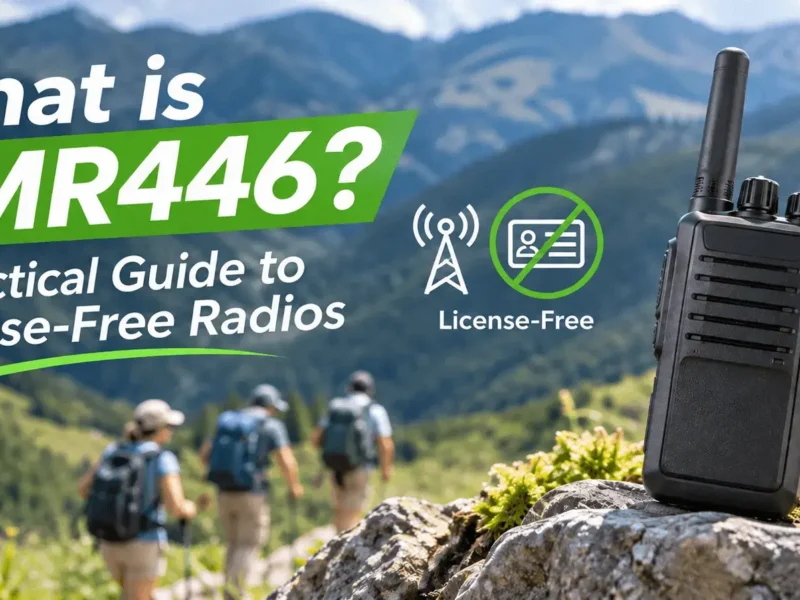
What is PMR446? It is a short-range radio service that uses shared frequencies around 446 MHz. In countries that permit it, people can use compliant equipment without an individual radio license.
The radios communicate directly with each other. They do not need a cellular network, internet connection, or monthly airtime subscription.

What is PMR446 and How Does It Work?
A user selects a channel, presses the push-to-talk button, and speaks. Other compatible radios within range can receive the call on that channel.
The service normally uses simplex communication. That means users take turns speaking and listening on the same radio channel.
PMR446 channels are shared. Another team nearby may use the same channel, so users should listen before transmitting and switch channels when necessary.

PMR446 Frequencies and Channels
The European PMR446 frequency range is 446.0 to 446.2 MHz. It sits in the UHF part of the radio spectrum.
The harmonized analog channel plan uses 12.5 kHz spacing. It provides 16 channel positions, starting at 446.00625 MHz. Older analog radios may offer only the first eight. Source: ECC Decision (15)05
Analog and Digital Operation
Analog radios send voice using an analog signal. Compatible analog models from different brands can usually communicate when their frequency and signaling settings match.
Digital radios encode voice as data. Digital PMR446 equipment can use different technologies, including DMR and dPMR. Two digital radios also need compatible protocols and settings.
An analog-only radio cannot understand a digital transmission. Some radios support both modes, but buyers should check the exact model and configuration.
Privacy Codes
Many analog radios offer CTCSS or DCS settings. These codes help a radio ignore calls that use a different code.
They do not encrypt speech or create a private channel. Other users can still transmit on that frequency, and a suitably configured receiver can hear the conversation.
Do You Need a License?
In the UK, users do not need an individual radio license for PMR446 equipment that meets the applicable exemption conditions. Businesses and individuals can both use the service.
The UK’s published interface requirement specifies 446.0–446.2 MHz and a maximum of 500 mW effective radiated power, or ERP. ERP describes radiated power under a specified reference, so it is not simply another name for the transmitter’s rated output. Source: Ofcom IR 2030, Table 3.18
European rules are changing. In October 2026, the ECC amended its harmonization decision to allow up to 1 W ERP, with a preferred national implementation date of April 30, 2027. That decision does not automatically replace each country’s current rules. Source: ECC Decision (15)05
Check the regulator’s requirements for every destination country. The UK limit above remains the reference in the Ofcom document reviewed for this article.
What is PMR446 Range Like in Practice?
There is no single distance that applies to every site. A clear path across an open field can support a much longer conversation than a path through concrete walls.
Shelving, machinery, hills, building layout, and the position of each user all affect reception. A radio held close to the body can also perform differently from one held upright in a clear position.
A range figure on a product box may come from favorable conditions. Treat it as a starting point, then test the radios where staff will actually work.
Where Do Businesses Use PMR446?
PMR446 can suit teams that work over a compact area and need quick group calls.
A restaurant might use radios between the kitchen and service floor. A small warehouse might use them between receiving and dispatch. Event staff could use them across a venue, provided the site test confirms coverage.

Shared channels can be inconvenient at busy locations. If several nearby teams transmit at once, staff may need another channel or a different radio solution.
PMR446 vs Licensed Radio and PoC
| Consideration | PMR446 | Licensed radio system | Push-to-talk over cellular |
|---|---|---|---|
| Typical connection | Direct radio-to-radio | Direct or through system infrastructure, depending on authorization | Cellular or other supported data network |
| Individual radio license | Not required where compliant use is exempt | Often required; rules depend on the country and authorization | Device users generally rely on the network operator’s spectrum authorization |
| Coverage | Short-range and site-dependent | Depends on frequencies, equipment, and system design | Depends on network coverage and service availability |
| Channel access | Shared with other users | Depends on the license; exclusivity is not automatic | Managed through a service and its user configuration |
| Ongoing costs | No airtime subscription for direct operation | License or system costs may apply | Service or data charges may apply |
PMR446 is a practical choice for a small site when shared channels and direct coverage are enough. A licensed system may suit a larger or more demanding operation.
PoC can connect teams across a wider area when network coverage is available. It also brings network and service dependencies that direct radio users should consider.
How to Choose and Test a Radio
Start with the work your team needs to do. List the locations staff must reach, the number of users, and the conditions around them.
Before ordering, check these points with the supplier:
- Market compliance. Ask for the exact model’s conformity documents and confirm the countries where it will operate.
- Compatibility. Check analog or digital mode, channel settings, and any required signaling or protocol.
- Daily use. Consider audio clarity, charging arrangements, accessories, and ease of operation.
- Working conditions. Select a suitable protection rating when staff face dust, rain, or cleaning.
- Site coverage. Test from the loading bay, stairwell, stockroom, and other locations where calls matter.
Use representative locations and normal working conditions during the test. If a call fails, move to another position or channel and test again. Record the result before buying a full fleet.
Frequently Asked Questions
Can Different Brands of PMR446 Radios Work Together?
Often, yes. Analog models need matching frequencies and compatible CTCSS or DCS settings. Digital models also need compatible digital protocols and configuration.
Check the manuals before placing a mixed-brand order. Matching channel numbers alone may not confirm a match.
Can I Use a Programmable Radio on PMR446?
A radio does not become compliant simply because it can transmit on 446 MHz. It must meet the equipment and operating requirements in the country of use.
For example, Switzerland’s regulator says amateur radio equipment is not authorized to transmit on PMR446 frequencies. Ask for documentation for the exact model and market. Source: Swiss Federal Office of Communications
Are PMR446 Conversations Private?
Ordinary analog conversations are not private. Privacy codes filter what a radio plays through its speaker; they do not stop others from receiving a transmission.
For sensitive information, assess the security features and legal requirements of a suitable alternative.
Choosing the Right System
The answer to what is PMR446 is straightforward: it is a way to make short-range radio calls on shared channels without an individual license where local rules permit.
The buying decision takes a little more work. Confirm the target country, check compatibility, and test coverage at the actual site.
If you are selecting radios for a workplace or distribution market, contact Chierda to discuss your coverage needs and destination countries. Request model-specific compliance documents before placing an order.