

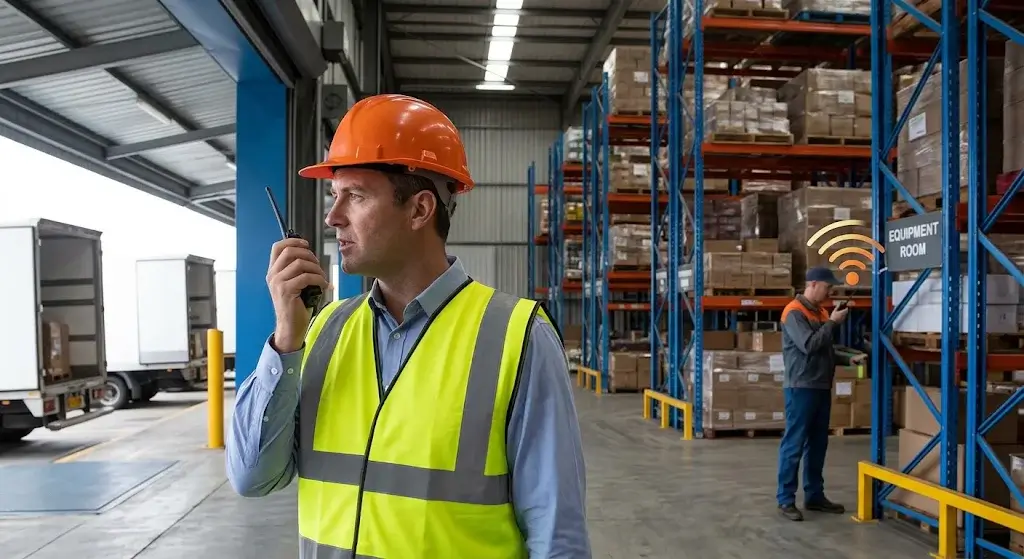
A warehouse supervisor can hear the loading dock, but the maintenance team disappears behind a row of metal racks. Moving a few steps helps. Once the maintenance worker returns to the equipment room, the signal fades again.
This is the kind of problem that leads many businesses to ask what is a repeater and whether one can improve radio coverage.
A two-way radio repeater receives a transmission from one radio and retransmits it for other radios to hear. A suitable location and antenna can help it reach areas where handheld radios struggle to communicate directly.
How Does a Radio Repeater Work?
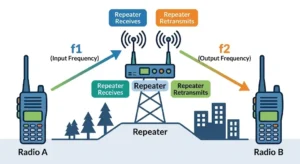
When a worker presses the push-to-talk button, the radio sends a signal to the repeater. The repeater receives it and transmits the message again. Other radios listen to that retransmission.
A typical system uses two frequencies. The repeater listens on its input frequency and transmits on its output frequency. Your radio does the reverse: it transmits on the repeater input and listens on the repeater output.
Think of the path like this:
Radio A → repeater input → repeater output → Radio B
Radio B follows the same path when its user replies. Each radio needs suitable coverage to and from the repeater.
What Equipment Does a Repeater System Need?
The repeater itself contains a receiver, transmitter, and control functions. A complete installation also needs an antenna, feed line, power supply, and a suitable site.
Many systems use a duplexer. This filter lets the receiver and transmitter share one antenna while reducing the transmitter’s effect on the receiver. An installer must select and tune it for the system’s frequencies. JASRA’s beginner’s guide explains these components in more detail.

What Is a Repeater Used For?
A repeater helps a team communicate across an area where direct radio-to-radio signals fall short. Businesses commonly consider one for large facilities, construction sites, campuses, transport operations, and properties with difficult terrain.
In the warehouse example, an elevated antenna might provide a better path to both the loading dock and the maintenance area. That outcome depends on the building and the installation. A site test is the way to find out.
A repeater can also support communication among users who already hear it but cannot reach each other directly. For example, two workers may operate on opposite sides of a large property.
How Far Can a Repeater Reach?
There is no reliable distance figure that applies to every site. Antenna height, terrain, buildings, interference, radio placement, frequency, and equipment performance all affect coverage.
The two directions deserve separate attention. A handheld radio may hear a powerful repeater transmission but struggle to reach the repeater with its own signal. If the repeater cannot receive the worker’s message clearly, increasing its output power will not solve that incoming path.
Basements, lift shafts, dense concrete, and metal structures can still create difficult areas. Some sites need a different antenna arrangement or a more complex system.
Repeater vs Direct Radio Communication
Direct communication is often called simplex. One radio transmits straight to another, usually on the same frequency. It needs no repeater site or repeater power supply.
| Consideration | Direct communication | Repeater communication |
|---|---|---|
| Signal path | Radio to radio | Radio through a repeater to another radio |
| Coverage | Depends on the direct path between users | Depends on each radio’s path to and from the repeater |
| Equipment | Compatible radios | Compatible radios plus repeater infrastructure |
| Cost and maintenance | Generally simpler | Adds equipment, installation, and maintenance |
If direct communication covers every required work area, a repeater may add unnecessary cost. Test the areas where people actually work before making that decision.
Analog and Digital Repeaters
An analog repeater works with compatible analog radio signals. The system may use a signaling tone, such as CTCSS or DCS, to control access or reduce unwanted audio. These tones do not provide privacy.
Digital systems use a compatible digital protocol. For example, DMR Tier II uses two time slots on a 12.5 kHz channel. A suitable repeater system can support two simultaneous communication paths, subject to its configuration and available features. DMR Association
Some equipment supports both analog and digital operation. Check the product documentation for the exact modes and operating conditions. Radios also need matching frequencies, protocol settings, and other relevant parameters.
What is a Repeater Going to Cost?
The repeater unit is only part of the budget. An antenna, duplexer, feed line, installation, licensing, and ongoing maintenance can add to the project cost.
Site access matters too. A rooftop may offer a useful antenna position, but it can involve permissions, cabling work, and weather protection. Backup power may also matter if the team needs communication during an outage.

Ask suppliers for a complete system proposal. It should identify the equipment, installation work, coverage assumptions, and any testing included in the price.
How to Choose a Repeater System
Start with a map of the places where staff need to communicate. Mark loading docks, stairwells, vehicle routes, equipment rooms, and any known dead zones.

Then discuss these requirements with a qualified supplier or installer:
- Coverage: Which areas must communicate with each other?
- Capacity: How many conversations must happen at the same time?
- Existing radios: Which models, frequency bands, and protocols does the team use?
- Site: Where can the antenna and equipment go, and who controls access?
- Power: Does the site need backup power?
- Authorization: Which frequencies and operating permissions apply locally?
The rules depend on the country and radio service. Confirm the applicable licensing and frequency requirements with the local regulator or a qualified licensing professional before transmitting.
Check Compatibility Before Ordering
A repeater-capable radio must support the necessary transmit and receive frequencies. It also needs the correct channel settings and any required access signaling.
For digital equipment, check the protocol, operating mode, time slot, talkgroup, and other relevant settings. Encryption and optional features need particular care when equipment comes from different manufacturers.
A shared frequency band alone does not guarantee interoperability. Ask for a compatibility check using the exact radio and repeater models.
Troubleshooting a Repeater System
If a radio can hear others but nobody hears its reply, check whether it can reach the repeater input. A weak battery, damaged antenna, poor location, or incorrect transmit setting may contribute to the problem.
If several radios lose coverage at once, check the repeater’s power and operating status. An installer can then inspect the antenna system, connections, interference, and duplexer.
If only one radio has trouble, compare its programming and antenna with a working unit. Use an authorized channel and follow the site’s test procedure.
Frequently Asked Questions
What is a repeater in a two-way radio system?
It is equipment that receives a radio transmission and retransmits it to other radios. A well-placed repeater can improve coverage across a site.
What is a repeater frequency pair?
It is the pair of frequencies used for the repeater’s input and output. The radios transmit on the input frequency and receive on the output frequency.
Does every walkie-talkie work with a repeater?
No. The radio must support the repeater’s frequencies and operating mode. Its programming must also match the system’s signaling and other settings.
Does a repeater need an internet connection?
A standalone local repeater can operate without internet access. Some multi-site systems use an internet or other network connection to link locations. Their operation depends on the system design.
What is a repeater’s biggest coverage limitation?
A repeater can only relay a usable transmission that reaches it. Difficult terrain, buildings, interference, and poor antenna placement can weaken the incoming signal.
Plan Around the Places That Matter
A repeater can give a radio system useful extra coverage, but the installation determines much of the result. Start with the areas where conversations fail, test both signal directions, and check compatibility before choosing equipment.
If your team is planning a radio system, share your site layout, existing radio models, and coverage requirements with Chierda. These details provide a practical starting point for discussing a suitable solution.