
In an age of apps, why do the pros still use CB radios? With GPS navigation and traffic apps in every pocket, it’s a fair question. Yet, on highways and rugged trails across the country, the airwaves are still alive with conversation. The truth is, a CB (Citizens Band) radio offers something no app can: real-time, unfiltered information directly from the people who are on the road with you. This is the ultimate cb radio guide for the modern driver.
What is a CB Radio? The Original, License-Free Social Network
Before the internet, there was the CB radio. It’s a system of short-distance, two-way radio communication that allows individuals to talk to one another over a shared set of public frequencies.
The 40 Channels You Can Use, No Test Required
The biggest advantage of CB radio in the US is that it is a completely license-free radio service. You can buy a radio, install it, and start talking on any of the 40 channel CB frequencies immediately. There are no tests to take and no forms to file.
How It’s Different from FRS, GMRS, and Ham Radio
While all are forms of two-way radio, CB operates in its own specific frequency band (27 MHz). It’s designed for public, non-commercial use and has a unique culture and set of rules that have been established over decades.

3 Modern Reasons to Own a CB Radio
So, why do you need one today?
For Truckers: Real-Time Traffic, Weather, and “Smokey” Reports
A traffic app can tell you there’s a slowdown ahead, but it can’t tell you why. A cb radio for truckers can. Your peers on the road will tell you which lane is closed, what the hazard is, or if there’s an unexpected weather front moving in. It’s the most immediate and accurate source of road intelligence.
For Off-Road Communication: Coordinating Your Convoy on the Trail
When you’re deep in the backcountry, cell service is the first thing to disappear. Off-road communication is essential for safety and coordination. A CB radio allows every vehicle in your convoy to stay in constant contact, warning others of obstacles, coordinating turns, or calling for help if someone gets stuck.
For Road Trippers: Connecting with the Local Scene and Enhancing Safety
For those on a cross-country adventure, a CB is more than a tool—it’s an experience. It connects you to the culture of the American road, and in an emergency in a no-service area, it can be your lifeline to help.
Choosing Your First CB: Handheld vs. Vehicle-Mounted
Your first major decision is the type of radio to buy.
-
Handheld CB Radios: These portable units are great for flexibility. You can easily move them between vehicles or carry them outside the car. They are perfect for off-road communication where a spotter needs to be on foot.
-
Vehicle-Mounted CB Radios: These are permanently installed in your vehicle and connect to a larger, external antenna. They offer the best possible range and performance and are the standard choice for professional truckers.

Getting on the Air: A Quick Start Guide to CB Radio Basics
Ready to talk? Here are the fundamentals.
Performing a “Radio Check” to Test Your Signal
The easiest way to see if you’re transmitting is to ask for a “radio check.” Go to an active channel (like 19), wait for a pause in conversation, and say, “Breaker one-nine for a radio check.” Someone will likely respond and tell you how clearly they can hear you.
Essential Lingo: “10-4,” “What’s your 20?,” and “Breaker 1-9”
-
10-4: Message received and understood.
-
What’s your 20?: What is your location?
-
Breaker 1-9: I want to start a conversation on Channel 19.
Key Channels: Understanding Channel 9 (Emergency) and 19 (Highway)
-
Channel 9: This channel is reserved by law for emergency communications only.
-
Channel 19: This is the unofficial highway channel used by truckers across the country for traffic and road condition updates.
The Chierda CB27: A Modern Take on a Classic Tool
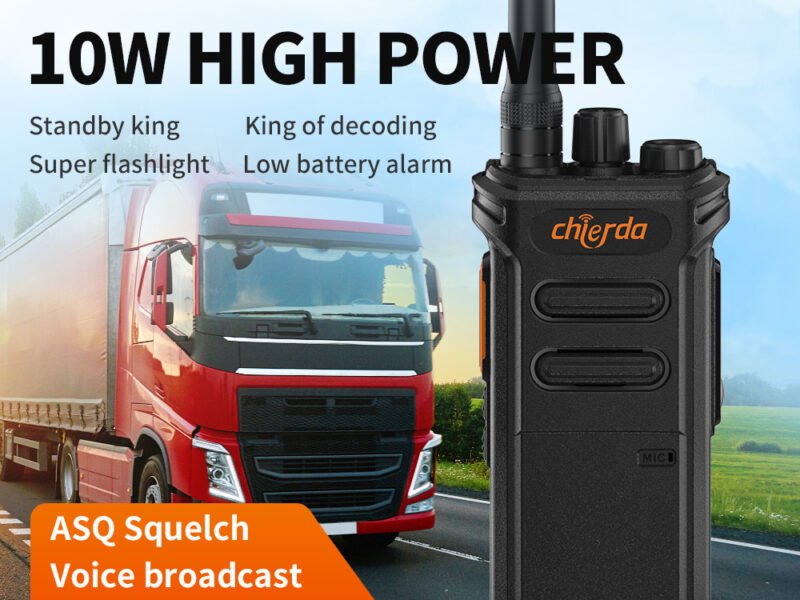
While the technology is classic, the hardware has evolved. A modern handheld like the Chierda CB27 offers the best of both worlds.
-
The Freedom of a Handheld Design: Take it from your truck to your car to the campsite.
-
Built for Durability: As a long-standing professional radio manufacturer, we build our devices to handle the bumps of the road or trail.
-
All 40 Channels in the Palm of Your Hand: Full access to the entire CB spectrum in a compact, easy-to-use package.
Join the Conversation on the Open Road
A CB radio is more than a piece of electronics; it’s a key to a community. It’s a tool for safety, efficiency, and connection. Whether you’re a professional driver or a weekend warrior, it’s time to get on the air and join the conversation.
FAQ: Your First CB Radio Questions Answered
What kind of range can I realistically expect from a CB radio?
Range is highly dependent on your antenna and terrain. A handheld might get 1-3 miles, while a vehicle-mounted unit with a good antenna can achieve 5-10 miles or more, especially in open country.
How important is the antenna for my CB radio?
It is the single most important factor for your range. A cheap radio with a great, properly tuned antenna will always outperform an expensive radio with a poor antenna.
What’s the difference between a CB radio and a Ham radio?
CB radio is a simple, 40-channel, license-free service for everyone. Ham radio is a much more powerful and complex hobby that requires a license to operate. It offers a vast range of frequencies and the potential for worldwide communication.
Are all 40 channels free for me to use?
Yes, you are free to use any of the 40 channel CB frequencies, with the exception of Channel 9, which should only be used for emergencies. If you’re looking for other options beyond CB, you can explore our full range of communication solutions on our website.