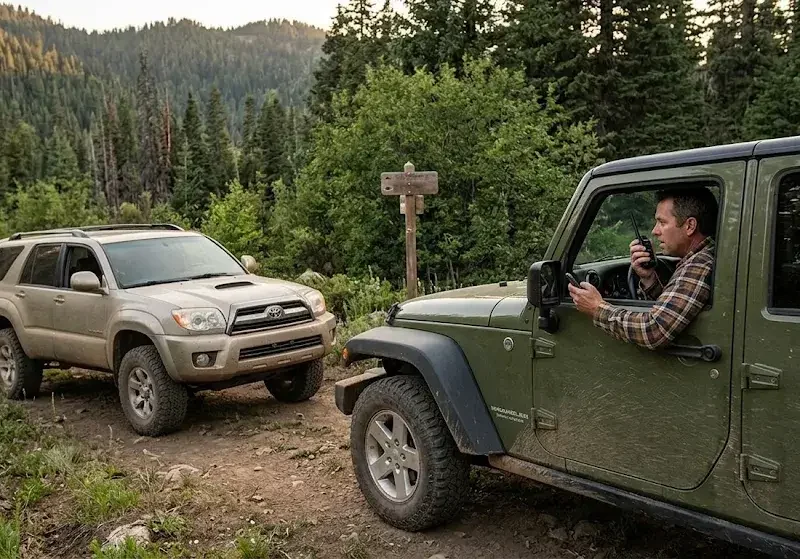
Picture two cars approaching a trail junction after losing phone service. The lead driver needs to tell the other driver which turn to take. A quick radio call can settle it, provided both vehicles remain within radio range.
That situation helps explain the interest behind what is GMRS radio. A GMRS radio provides local, two-way communication through the General Mobile Radio Service. In the United States, the service uses designated UHF channels around 462 and 467 MHz. Operators use handhelds, vehicle radios, base stations, and repeaters under FCC rules. See the GMRS service rules.
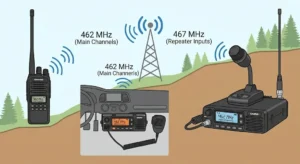
The appeal is straightforward. You press a button, speak, and release it to listen. Direct communication needs no cellular connection. Your choice of equipment, antenna position, and terrain will determine whether the other person actually hears you.
This guide covers US rules. Check local requirements before taking American GMRS equipment abroad.
What is GMRS Radio Used For?
GMRS suits conversations within a local group. Families can coordinate across a campground, drivers can keep a convoy together, and neighbors can arrange check-ins during an outage. Each operator still needs the appropriate authorization.
For an illustrative camping trip, one family member might carry a handheld while another stays beside the vehicle. They select the same channel and take turns speaking. Radio users call this direct, same-frequency arrangement simplex operation.
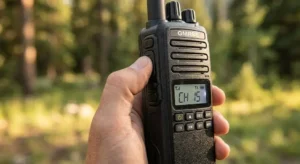
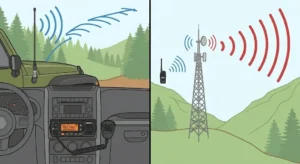
Handhelds offer portability. A vehicle radio can use an antenna outside the metal cabin, which often improves the radio path. A repeater adds another station that receives and retransmits calls across a wider area. Cobra’s GMRS FAQ explains these equipment options.
GMRS can help a group stay in touch when phones fail. It cannot guarantee contact with emergency services. Make a communication plan before the trip, including a backup channel and agreed check-in times.
Licensing Before Your First Transmission
For a first-time buyer, what is GMRS radio licensing going to cost? is a sensible follow-up question. The FCC currently charges $35 for a new application. A normal license lasts ten years, and GMRS requires no examination. The application fee schedule confirms the fee. The FCC also discusses the absence of testing in its fee order.
Applicants must meet FCC eligibility requirements, including a minimum age of 18. A license holder may authorize immediate family members to operate, including children, parents, siblings, grandparents, and other qualifying relatives. Friends do not qualify simply because they join your trip. Check the complete family and eligibility rules.
Apply through the FCC’s licensing system and wait for the grant before routine transmission. Buying the radio or paying the fee does not complete that process.
Use your assigned call sign after a transmission or a series of transmissions. During a series longer than 15 minutes, identify after 15 minutes and at least every 15 minutes thereafter. The station identification rule sets those intervals.
Selecting low power on a GMRS radio does not remove the license requirement.
GMRS vs FRS and the Power Limits That Matter
For shoppers comparing walkie-talkies, what is GMRS radio often leads straight to questions about FRS. Family Radio Service offers short-distance communication without an individual license application. GMRS adds equipment options, including vehicle installations and repeater operation.
Both services share 22 channels. Compatible radios can talk directly when their frequencies and receive settings match. GMRS also has eight main frequencies for repeater inputs, bringing its allocation to 30 channels. Those extra frequencies do not provide eight more ordinary direct-talk channels. See the GMRS channel allocation.
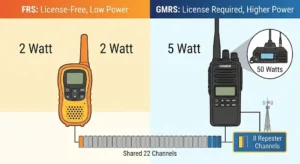
| Common channel group | GMRS power limit | FRS power limit |
|---|---|---|
| 1–7 | 5 W ERP | 2 W ERP |
| 8–14 | 0.5 W ERP, handheld units only | 0.5 W ERP |
| 15–22 | Up to 50 W transmitter output for mobile, base, and repeater stations | 2 W ERP |
ERP means effective radiated power and accounts for the antenna system. Transmitter output measures power at the radio’s output. These figures describe different things. The table follows the GMRS power limits and FRS power limits.
The 50 W figure is a legal ceiling for those station types on main channels. It does not describe every handheld’s output. Specialized fixed stations have a separate 15 W limit on main channels. Always check the model’s specifications and its channel restrictions.
FRS radios have integral antennas and cannot transmit into GMRS repeaters. GMRS models may offer removable antennas and repeater support. Check both features before buying. Cobra’s comparison of FRS and GMRS covers these differences.
What is GMRS Radio Range Really Like?
A distance on a box cannot describe your campsite or neighborhood. Hills, buildings, vegetation, and antenna height all affect coverage. Clear paths between antennas help. A ridge can interrupt contact even when the radios sit close together on a map.
For context, Cobra lists roughly 1.5 to 3 or more miles across flat, open terrain for its 2 W handheld category. Its estimate between buildings falls to about 675 feet through half a mile. These are manufacturer guidelines for that equipment class, not measurements of your proposed system. See Cobra’s range guidance.
More transmitter power cannot guarantee a usable path through a hill. Antenna placement may help more than a higher power setting. For a vehicle installation, consider the antenna location and cable losses alongside the radio’s rated output.
I would want a route test before trusting any mileage claim. Check both directions of each conversation, especially where vehicles or buildings obstruct the path. Hearing a powerful base station does not prove that it can hear your handheld.
How Repeaters Extend Coverage
A repeater receives your transmission and sends it out again on another frequency. An elevated repeater antenna can reach users who cannot talk directly to one another. Coverage still depends on each user’s path to the repeater.
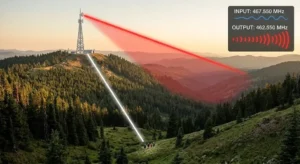
A common GMRS pair uses 467.550 MHz for the repeater input and 462.550 MHz for its output. Your radio transmits on the higher frequency and listens on the lower one. That arrangement gives your radio a positive 5 MHz transmit offset. The channel rules list the available frequencies.
Choose a radio with repeater support, then obtain the correct frequency pair and access tone. Follow the owner’s access policy. Owners may open their repeaters to other users or restrict access under the licensing rules.
Keep a direct channel available. A repeater may lose power, fall outside your route, or simply fail to hear a handheld behind an obstruction.
Buying a Radio That Fits the Job
For a dealer answering what is GMRS radio, certification belongs beside the explanation of frequencies. A programmable UHF radio does not qualify just because it can tune to a GMRS channel. Verify authorization for the exact model and variant. The GMRS certification rule requires service-specific transmitter certification.
Start with where the radio will work. Someone walking around a campsite needs accessible controls, useful audio, and manageable weight. A vehicle installation needs suitable power wiring, an external antenna, and a microphone within reach.
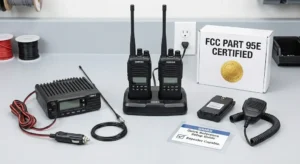
Ask the supplier for the FCC ID and the corresponding equipment grant. Confirm repeater operation if your plan needs it. Request battery runtime under a stated duty cycle, rather than estimating hours from battery capacity alone. Match any claimed environmental rating to the exact product variant.
For a larger order, test samples with the accessories customers will receive. Check charging, audio, channel settings, and coverage. Include a radio from any existing fleet in the compatibility test.
Business Use Needs an Operator Plan
The FCC permits qualifying GMRS users to discuss personal or business activities. That permission does not give an employer a license covering unrelated employees. New licenses go to individuals, while some older organizational licenses retain limited grandfathered rights. See the permissible-use rule and operator eligibility rule.
A procurement team should identify every operator’s authorization before ordering radios. Shared-channel congestion, staff turnover, and required coverage also deserve attention. For a workplace deployment, ask a supplier to compare services that fit the actual operator group.
Questions Buyers Often Ask
What is GMRS Radio Privacy Like?
Other people can hear your transmissions. CTCSS tones and DCS codes control which incoming signals open your speaker. They do not encrypt your voice, reserve a channel, or create extra frequencies. A listener with receive-tone filtering disabled can hear you on the same channel. Cobra explains this behavior in its CTCSS and DCS guide.
For a direct-radio test, select the same channel and temporarily disable receive-tone filtering on both sets. If communication works, compare the tone settings before restoring them. Listen for other traffic before transmitting.
Will Different Brands Work Together?
Compatible analog GMRS radios can communicate across brands. Match the frequency, receive tones, and appropriate bandwidth settings. For repeater use, also check the transmit offset and access tone. Use the manuals and test the actual radios together.
Will a GMRS Radio Work Without a Repeater?
Yes. Direct operation lets radios communicate on the same channel within their mutual coverage area. You can use this arrangement without cellular service or a repeater. Agree on a direct channel before the group separates.